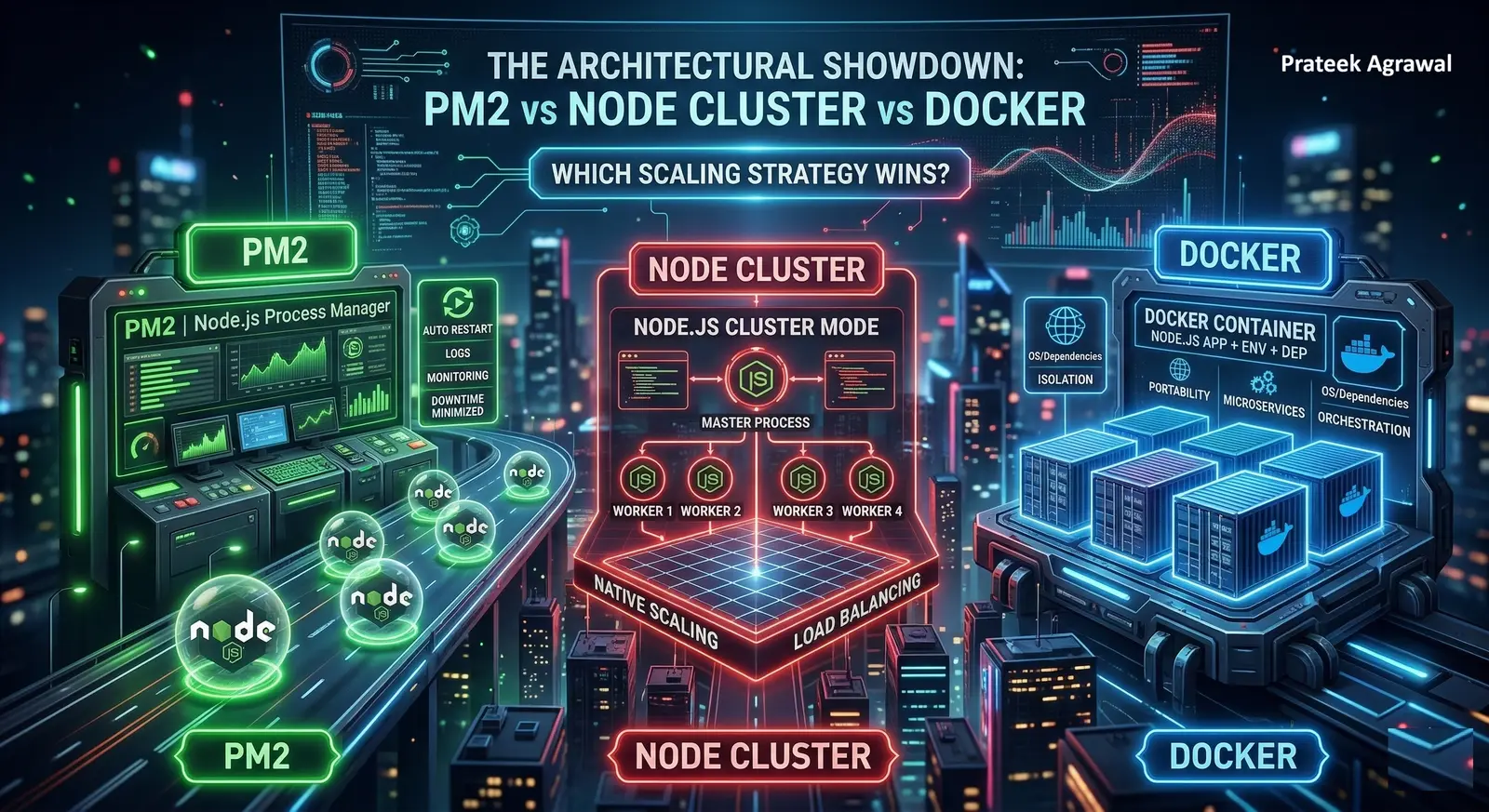
Backend engineers often ask whether PM2 vs Node Cluster vs Docker is the right choice for scaling Node.js in production. The debate usually goes in circles because these tools are not direct alternatives. Each one solves a different layer of the stack.
Key points
- PM2 manages Node processes: restarts, zero-downtime reloads, logs, and monitoring.
- Node Cluster forks workers to use all CPU cores on a single server.
- Docker packages applications for consistent, portable deployment and cloud scaling.
Why Node.js needs scaling
Node.js runs on a single-threaded event loop. This makes it extremely efficient for asynchronous operations, but it also means a single Node.js process only uses one CPU core.
On a server with 8 cores, one Node process leaves 7 cores unused. That is why scaling strategies become necessary.
The three tools often discussed are:
- PM2
- Node Cluster
- Docker
Each one operates at a different layer of the stack.
PM2 vs Node Cluster vs Docker: what each tool solves
What PM2 does
PM2 is a Node.js process manager designed for production.
Instead of starting your app like this:
node app.js
You run it with:
pm2 start app.js
PM2 adds critical production features:
- Automatic restarts if your app crashes
- Zero-downtime reloads
- Log management
- Process monitoring
Architecture:
Node App
   ↓
PM2
   ↓
Server
PM2 is perfect for:
- Single server deployments
- Small to medium production systems
- Teams wanting simple and reliable process management
For many applications, PM2 alone is enough.
What Node Cluster does
The Node.js cluster module allows multiple Node processes to share the same port. This lets your application use all CPU cores.
const cluster = require("cluster");
const os = require("os");

if (cluster.isPrimary) {
  const cpuCount = os.cpus().length;

  for (let i = 0; i < cpuCount; i++) {
    cluster.fork();
  }
} else {
  require("./app");
}
Each worker handles incoming requests.
Architecture:
Load Balancer
      ↓
Node Cluster
 ├ Worker
 ├ Worker
 ├ Worker
 └ Worker
Benefits:
- Uses all available CPU cores
- Higher concurrency
- Better performance under load
However, cluster mode does not handle process monitoring or restarts. That is where PM2 can help.
What Docker does
Docker solves a completely different problem. Instead of managing processes, Docker packages your app and dependencies into containers. This ensures your application runs exactly the same everywhere.
Benefits:
- Environment consistency
- Dependency isolation
- Reproducible deployments
- Easy scaling with orchestration tools
Architecture:
Docker Container
     ↓
Node.js App
     ↓
Cloud / Server
In larger systems, Docker is usually combined with:
- Kubernetes
- Docker Swarm
- ECS
These systems handle:
- container scaling
- rolling deployments
- self-healing
- service discovery
PM2 vs Node Cluster vs Docker: comparison
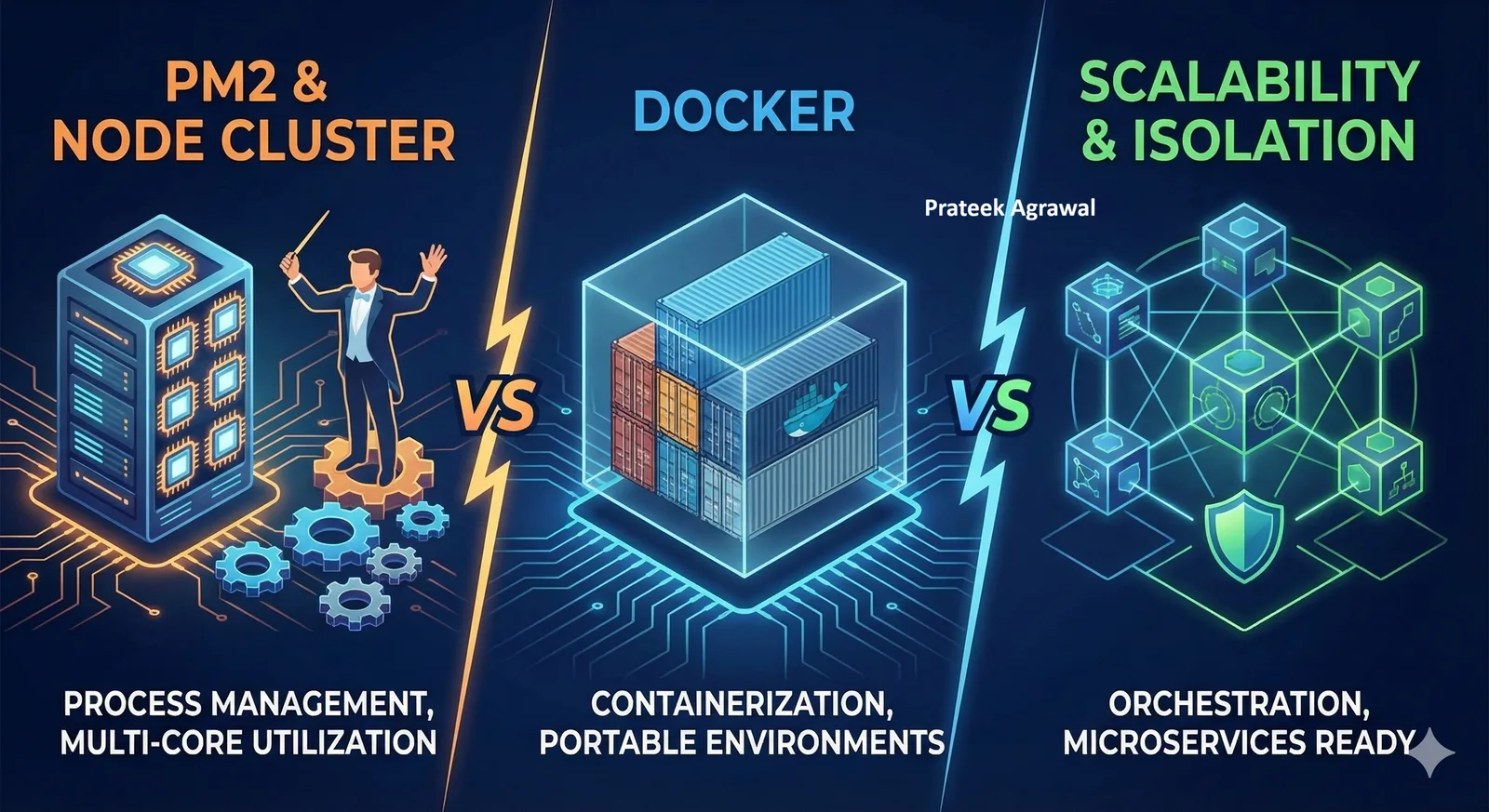
Many engineers treat these tools like alternatives. But they actually operate at different layers.
| Tool | Problem It Solves |
|---|---|
| PM2 | Process management |
| Node Cluster | CPU utilization |
| Docker | Deployment portability |
In real production systems, they are often used together.
How to combine them in real setups
Example 1: simple VPS
Node.js App
   ↓
PM2
   ↓
Single VPS
Simple and reliable.
Example 2: multi-core server
Node Cluster
   ↓
PM2
   ↓
Server
Maximizes CPU utilization while keeping process management.
Example 3: cloud native architecture
Docker Container
   ↓
Kubernetes
   ↓
Multiple Servers
In Kubernetes environments, PM2 is often unnecessary because Kubernetes already manages restarts and scaling.
How to choose the right tool
Instead of asking:
Which one is better?
Ask:
What problem am I solving?
| Scenario | Recommended Tool |
|---|---|
| Single VPS deployment | PM2 |
| Need multi-core performance | Node Cluster |
| Cloud / container deployment | Docker |
| Kubernetes infrastructure | Docker + Kubernetes |
FAQ
Is PM2 required inside a Docker container?
In a plain Docker container, PM2 can manage the Node process and restart it on failure. In Kubernetes, the platform usually handles restarts, so PM2 is often unnecessary.
Does Docker replace Node Cluster?
No. Docker packages the application, while Node Cluster forks worker processes to use more CPU cores. They can work together on large multi-core instances.
When should I use Kubernetes over PM2?
Use Kubernetes when you need container orchestration across multiple servers, rolling deployments, service discovery, and self-healing. PM2 is enough for simple single-server deployments.
The real lesson
Most architecture debates waste time arguing about tools instead of requirements. Good engineering starts with the problem you are solving. Once you identify the layer, the choice between PM2, Node Cluster, and Docker becomes much simpler.