
After working on several production systems, I have seen teams debate testing strategies endlessly, while a green pipeline says little about what will break in production. The five core types of software testing—unit, integration, end-to-end, performance, and security—form a defense system that catches bugs before users do.
Key points
- Unit tests verify single functions or components in isolation.
- Integration tests catch failures between systems and services.
- End-to-end, performance, and security tests protect the full production experience.
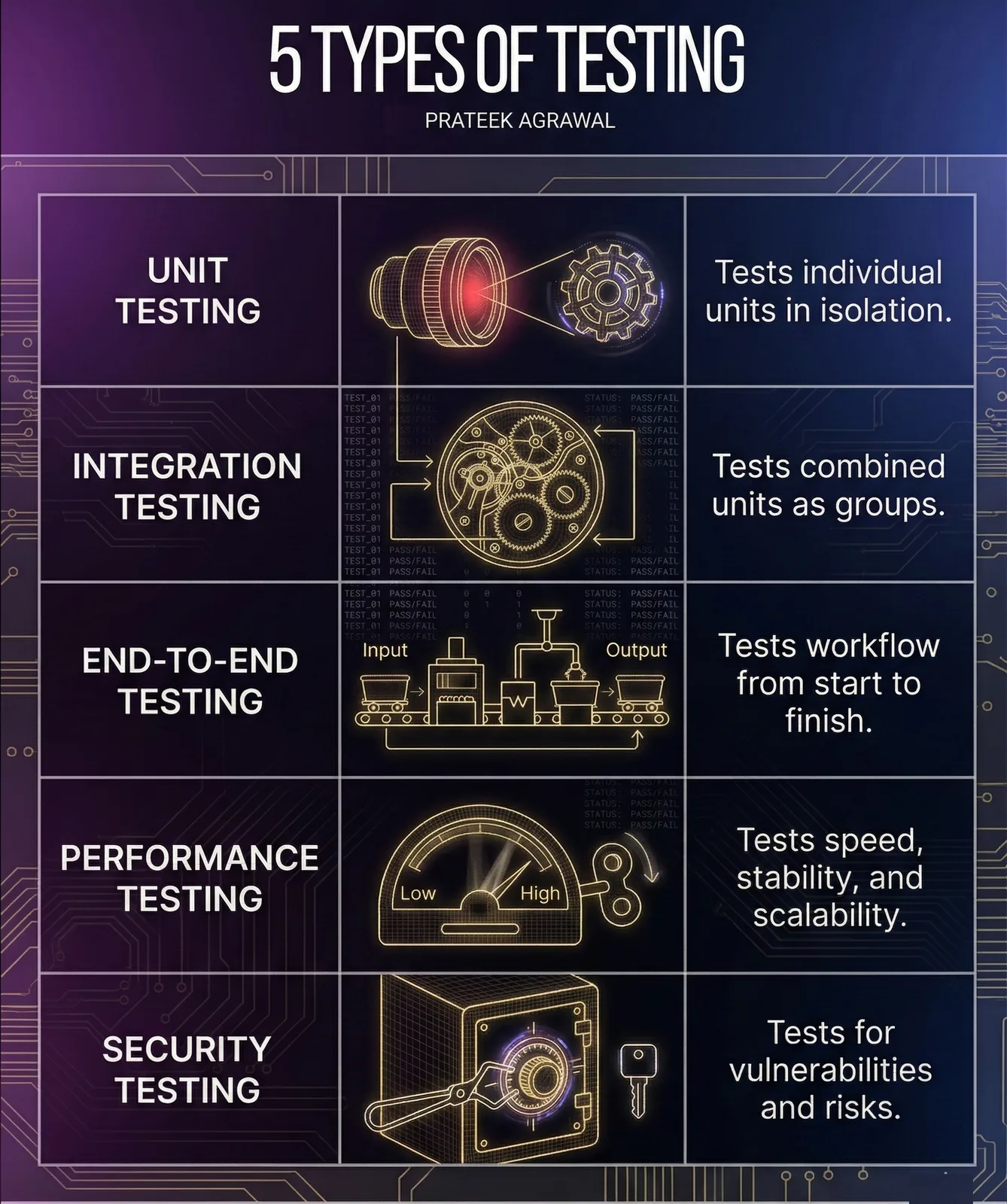
What Are the Types of Software Testing?
| Testing type | What it checks | Main goal | Common tools |
|---|---|---|---|
| Unit | A single function, component, or class in isolation | Verify core logic before integration | Jest, Vitest, Mocha |
| Integration | Multiple components, services, or systems working together | Catch contract bugs between systems | Supertest, Postman, Jest |
| End-to-end | The entire user journey from UI to backend | Verify real user workflows | Cypress, Playwright, Selenium |
| Performance | System behavior under real-world load | Find bottlenecks before users do | k6, Apache JMeter, Lighthouse |
| Security | Vulnerabilities in code, config, and access | Stop attackers before exploits happen | Snyk, OWASP ZAP, SonarQube |
What Is Unit Testing?
Unit testing means testing a single function, component, or class in isolation.
Goal: ensure the core logic works before it interacts with anything else.
Example:
function add(a, b) {
  return a + b
}

test("adds numbers correctly", () => {
  expect(add(2,3)).toBe(5)
})
Common tools: Jest, Vitest, Mocha.
Pro tip: If your unit test requires a database connection, it is probably not a unit test. It is an integration test.
What Is Integration Testing?
Integration testing checks how multiple components or services work together. Typical interactions include API-to-database, service-to-service, and queue-to-worker.
Goal: catch bugs in the contracts between systems.
A unit test can pass while two services break when integrated.
Example:
request(app)
  .get("/users")
  .expect(200)
Common tools: Supertest, Postman, Jest with mocks.
What Is End-to-End Testing?
End-to-end testing exercises the entire application from the user's perspective. It simulates real user actions such as login, browse, add to cart, checkout, and payment.
Goal: verify the system works as a real user experiences it.
Users do not care about unit tests. They care whether the checkout button works.
Common tools: Cypress (my personal favorite), Playwright, Selenium.
These tests are slower but valuable. They catch silent failures unit tests never see.
What Is Performance Testing?
Performance testing checks how the system behaves under real-world load.
Example:
- 10 users: everything works.
- 10,000 users: API response goes from 200ms to 5s.
Goal: identify bottlenecks before users do.
Systems rarely crash immediately. They slow down first, and slow systems quietly kill conversions.
Common tools: k6, Apache JMeter, Lighthouse for frontend performance.
What Is Security Testing?
Security testing proactively searches for vulnerabilities.
Common risks include:
- SQL injection
- Cross-site scripting (XSS)
- Broken authentication
- Over-permissive IAM roles
Goal: prevent security issues before attackers find them.
One vulnerability can undo months of engineering work.
Common tools: Snyk, OWASP ZAP, SonarQube.
What Is the Testing Pyramid?
Not all tests should exist in equal numbers. A healthy testing strategy looks like this:
        E2E Tests
      Integration
     Unit Unit Unit
Unit tests are fast, cheap, and easy to maintain. E2E tests are slower, expensive, and harder to maintain, but they validate real user workflows.
An ideal strategy includes:
- Many unit tests
- Some integration tests
- A few critical end-to-end tests
How Do You Build a Testing Strategy You Can Trust?
Great teams do not obsess over coverage numbers. They focus on confidence in production.
Before every deployment, ask:
Do we actually trust this release?
If one testing layer is missing, you are not shipping software. You are shipping hope.
FAQ
What are the five types of software testing?
The five core types are unit, integration, end-to-end, performance, and security testing. Each layer checks a different part of the application.
Which type of testing should we automate first?
Start with unit tests because they are fast, cheap, and catch logic errors early. Then add integration tests around critical service boundaries.
How many end-to-end tests should we keep?
Keep E2E tests to a small set of critical user journeys. They are slower and harder to maintain, so reserve them for workflows that must work.